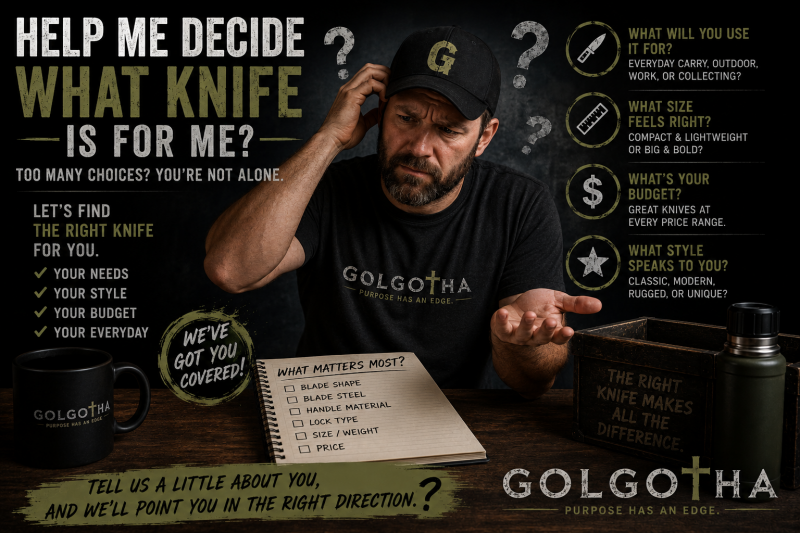
Help Me Decide: What Knife Is Right for Me?
A Beginner’s Guide to Choosing Your First Knife
So you’ve decided you want a knife.
Great.
Now you start shopping and discover approximately nine million choices.
Fixed blade or folder? Drop point or Wharncliffe? D2 or 14C28N? G10 or Micarta? Liner lock, button lock, crossbar lock…
And somehow buying a pocket knife has started feeling like you’re choosing options on a new truck.
Don’t worry.
Choosing a good knife doesn’t have to be complicated.
You don’t need the most expensive knife, the newest steel, or whatever somebody on the internet says is the greatest knife ever made.
You need a knife that fits you.
Let’s figure out what that looks like.
Question #1: What Are You Going to Do With It?
This is the best place to start.
Don’t ask:
“What’s the best knife?”
Ask:
“What do I need my knife to do?”
Your answer immediately narrows down the choices.
Everyday Carry
If you want something for opening packages, cutting tape, breaking down cardboard, cutting cord, and handling ordinary daily tasks, you’re probably looking for an EDC folding knife.
For most people, this is a great starting point.
Look for something comfortable to carry, easy to operate, and large enough to handle normal cutting tasks without becoming a brick in your pocket.
Work Knife
Maybe your knife isn’t going to spend much time looking pretty.
It’s going to work.
Warehouse workers, truck drivers, farmers, tradespeople, mechanics, landscapers, and plenty of other working men and women use knives constantly.
In that case, prioritize:
Comfort, dependable construction, good grip, reasonable edge retention, and easy maintenance.
A fancy handle and exotic steel aren’t nearly as important if you’re going to cover the knife in tape residue by Tuesday.
Outdoor Use
Camping, hiking, hunting, fishing, and general outdoor use may call for something different.
A sturdy folding knife can handle plenty of outdoor jobs, while a fixed blade provides simplicity and strength because there is no pivot or folding mechanism.
If you’re regularly around water or humidity, corrosion resistance may also become more important.
Collecting
There’s another perfectly legitimate reason to buy a knife:
Because you like it.
Maybe it’s a traditional pocket knife with beautiful bone handles.
Maybe it’s titanium and premium steel.
Maybe it’s bright orange and looks ridiculous.
If you’re collecting rather than buying strictly for utility, specifications aren’t everything.
Sometimes the right knife is simply the one that makes you say:
“Yep. I want that.”
We understand.
Question #2: Folding Knife or Fixed Blade?
This decision eliminates a lot of options.
Folding Knife
A folding knife is usually the easiest choice for everyday carry.
The blade folds safely into the handle, making the knife compact and convenient to carry in your pocket.
Modern folders are available with numerous opening methods and locking mechanisms.
A folder is probably right for you if you want:
- Convenient pocket carry
- Compact size
- Everyday utility
- A pocket clip
- Easy storage
- Lots of styles and options
For most beginners looking for an everyday knife, a folding knife is an excellent place to start.
Fixed Blade
A fixed blade doesn’t fold.
The blade and handle remain in one solid configuration, and the knife is typically carried in a sheath.
Fixed blades have no pivot or locking mechanism to maintain, which makes them simple and dependable.
Consider one if you want:
- A dedicated outdoor knife
- A hunting or camp knife
- A work knife for harder cutting tasks
- Simple construction
- Easy cleaning
- A knife carried in a sheath rather than a pocket
Some people also enjoy compact fixed blades for everyday carry.
Question #3: How Big Should It Be?
Bigger isn’t automatically better.
Neither is smaller.
For an everyday pocket knife, something around a 3-inch blade is a very comfortable starting point for many users.
It’s large enough for most ordinary tasks without becoming cumbersome.
Smaller knives can be fantastic when portability is the priority.
Larger folders provide more blade and handle, which some people prefer—especially those with larger hands.
Think about both blade length and handle length.
A knife can have a great blade but still be uncomfortable if the handle doesn’t fit your hand.
Also remember to check the knife laws where you live or travel. Blade-length and carry restrictions can vary by location.
Question #4: What Blade Shape Do I Need?
You don’t need to memorize every blade shape ever invented.
For a beginner, understanding a few common ones is enough.
Drop Point
If you don’t know what you want, a drop point is a great place to start.
It’s one of the most versatile blade shapes available and works well for general everyday cutting.
Clip Point
A clip point has a more pronounced, fine tip and is common on both traditional and modern knives.
It’s a classic, versatile design.
Wharncliffe
A Wharncliffe typically gives you a long, mostly straight cutting edge and a tip that sits relatively low.
These are excellent utility cutters and work especially well for packages, cardboard, tape, and similar everyday jobs.
Sheepsfoot
A sheepsfoot-style blade generally emphasizes a useful cutting edge while reducing the prominence of the tip.
They’re popular for utility work and everyday cutting.
Tanto
Tanto blades have a distinctive angular profile and strong-looking tip geometry.
Some people choose them for their design and tip characteristics.
And some people choose them because they simply look cool.
That’s allowed too.
Question #5: What Blade Steel Should I Choose?
This is where beginners often get overwhelmed.
Don’t.
There are plenty of good knife steels.
For an affordable everyday knife, steels such as D2, 14C28N, 440C, 8Cr13MoV, and similar established steels can provide plenty of real-world performance.
As you move into higher price ranges, you’ll encounter steels such as 154CM, Nitro-V, S35VN, MagnaCut, M390, and many others.
Generally, think about four things:
Edge retention — How long does it stay sharp?
Toughness — How resistant is it to chipping or damage?
Corrosion resistance — How well does it resist rust?
Sharpenability — How difficult is it to sharpen?
Don’t buy a knife solely because somebody told you its steel is better.
For most everyday users, proper heat treatment and good knife design matter tremendously.
Question #6: What Handle Material Should I Choose?
This mostly comes down to comfort, grip, weight, appearance, and budget.
G10
Strong, durable, moisture resistant, and easy to texture.
Excellent for working knives and EDC.
Micarta
Durable with a warmer, more natural feel.
Great for users who like a rugged look and comfortable grip.
FRN
Lightweight, durable, affordable, and practical.
Excellent when keeping weight and cost down matters.
Aluminum
Provides a solid metal feel without excessive weight.
Good for modern EDC knives.
Carbon Fiber
Strong, lightweight, and distinctive.
Popular on lightweight and more premium designs.
Titanium
Strong, corrosion resistant, relatively lightweight, and premium.
Common on higher-end folding knives.
Wood or Bone
Classic materials with natural character.
Perfect if traditional knives are more your style.
There isn’t a winner here.
Pick what feels and looks good to you.
Question #7: Which Lock Should I Choose?
Here comes another rabbit hole.
You’ll encounter liner locks, frame locks, button locks, crossbar-style locks, back locks, and numerous other designs.
All can work well when properly designed and manufactured.
For a beginner, focus on whether you can comfortably and confidently operate the mechanism.
Button and crossbar-style locks are popular because they’re easy to operate and generally allow your fingers to remain away from the blade’s closing path when disengaging the lock.
Liner locks are extremely common, simple, and proven.
Back locks have been around for generations.
You don’t need the newest locking system.
You need one you understand and can use safely.
Question #8: How Much Should I Spend?
Here’s some good news:
You don’t need to spend $300 to get a good knife.
Modern manufacturing has made some remarkably capable knives available at affordable prices.
Decide what you’re comfortable spending first.
Then find the best combination of design, materials, construction, and features within that budget.
Don’t stretch your budget simply because somebody says you need premium steel.
You probably don’t.
At the same time, there’s nothing wrong with spending more for premium materials, craftsmanship, design, or simply because you enjoy collecting knives.
Your money. Your knife.
A Simple Beginner’s Formula
Still confused?
Start here:
For a general everyday carry knife, look for a comfortable folding knife with roughly a 3-inch blade, a reputable blade steel, a handle material that provides good grip, and a locking mechanism you can operate confidently.
That’s it.
You can fine-tune your preferences later.
Your first knife doesn’t have to teach you everything about knives.
It just needs to teach you what you like.
Maybe you’ll discover that you love button locks.
Maybe you hate large knives.
Maybe you prefer Micarta over G10.
Maybe you become obsessed with Wharncliffe blades.
Maybe six months from now you somehow own 37 knives and you’re trying to explain to your spouse why they’re all completely different.
We can’t help you with that last part.
Don’t Chase Specifications
One of the easiest mistakes for beginners is buying specifications instead of buying a knife.
Premium steel.
Titanium.
Carbon fiber.
Fancy lock.
High HRC.
None of those things individually guarantees that you’ll enjoy carrying the knife.
A $50 knife that fits your hand perfectly and does everything you need may be a much better knife for you than a $300 knife that spends its life sitting in a box.
Specifications help you understand a knife.
They don’t tell you whether you’ll love it.
The Best Knife Is the One That Fits You
After spending enough time around knives, you’ll develop preferences.
That’s part of the fun.
Your first knife helps you figure out your second.
Your second helps you figure out your third.
And your 47th apparently helps you figure out why you need number 48.
The important thing is to start with what you actually need.
Consider your use, size, budget, blade shape, steel, handle, and locking preference.
Then choose something you like.
Don’t worry about knowing everything.
Everybody in the knife community was a beginner once.
Learn as you go.
Ask questions.
Carry your knife.
Use it.
And enjoy discovering what works for you.
Golgotha — Purpose Has An Edge.