Beginner’s Guide to Knife Blade Steel
What those letters and numbers actually mean
If you’ve ever shopped for a knife, you’ve probably seen names like D2, 14C28N, 440C, 8Cr13MoV, Nitro-V, S35VN, or M390 listed in the specifications.
If you’re new to knives, those names probably don’t mean much.
That’s okay.
You don’t need to be a metallurgist to choose a good knife. Understanding a few basic things about blade steel can help you know what you’re buying and choose a knife that fits how you plan to use it.
What Is Blade Steel?
At its simplest, knife steel is an iron-based alloy containing carbon and other elements that affect how the steel performs.
Manufacturers can change the composition of a steel to emphasize different characteristics. Some steels are designed to hold an edge for a long time. Others prioritize toughness, corrosion resistance, ease of sharpening, or a balance of several qualities.
That’s why there really isn’t one “best knife steel.”
There are simply different steels that are better suited to different jobs, budgets, and users.
The Four Things to Understand
When comparing blade steels, you’ll usually hear four characteristics discussed.
Edge Retention
Edge retention describes how long a blade can continue cutting effectively before it needs to be sharpened.
A steel with excellent edge retention can stay sharp through a lot of cutting.
That sounds like something everyone should want—and generally it is—but there can be tradeoffs. Steels with very high wear resistance may also take more time and effort to sharpen.
Toughness
Toughness is a steel’s ability to resist chipping, cracking, or breaking when subjected to impact or stress.
This can be especially important in larger fixed blades and working knives that may see harder use.
Don’t confuse toughness with hardness. A very hard steel isn’t necessarily a very tough steel.
Corrosion Resistance
Corrosion resistance is exactly what it sounds like: how well the steel resists rust and corrosion.
This becomes especially important if you live in a humid environment, work around water, sweat heavily while carrying your knife, or simply don’t want to spend much time maintaining your blade.
Stainless steels generally provide better corrosion resistance than carbon and many tool steels, although even stainless steel can corrode under the right conditions.
Ease of Sharpening
Eventually, every knife gets dull.
Some steels are relatively easy to bring back to a sharp edge with basic sharpening equipment. Others are extremely wear-resistant and may require more time or better abrasives.
For someone learning to sharpen, a steel that’s easy to maintain can actually be a major advantage.
So Why Are There So Many Different Steels?
Because knife users want different things.
Someone carrying a pocket knife to open packages and cut cardboard has different needs than someone carrying a fixed blade outdoors.
A fisherman may put a high priority on corrosion resistance.
Someone who uses a knife constantly at work may care more about edge retention.
Another person may simply want an affordable knife that’s easy to sharpen and dependable.
Steel manufacturers create different alloys to achieve different combinations of those characteristics.
Some Common Knife Steels
Here are a few steels you’re likely to encounter when shopping for modern knives.
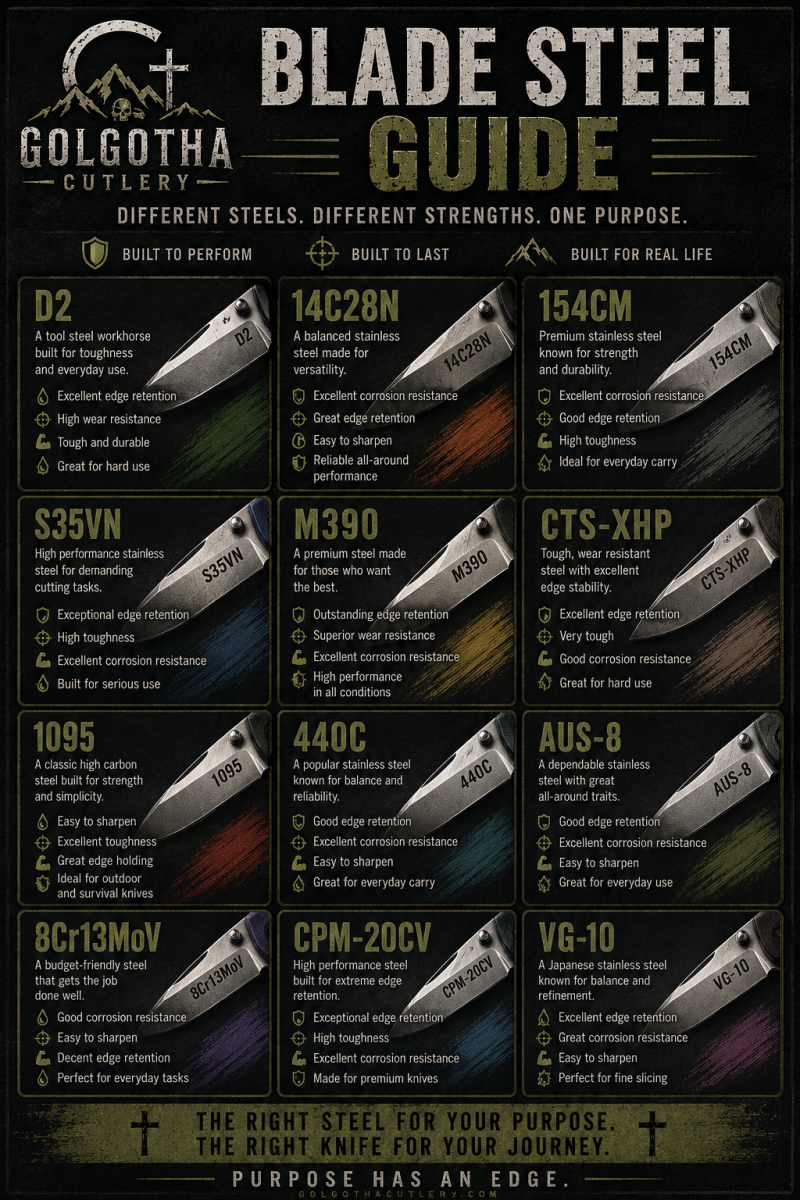
D2
A very popular tool steel used in countless affordable working knives. D2 is known for good wear resistance and edge retention. It isn’t considered a true stainless steel, so keeping it clean and dry is a good idea.
14C28N
A stainless steel originally developed by Sandvik. It offers an excellent combination of toughness, corrosion resistance, edge performance, and ease of sharpening. It’s become extremely popular in modern EDC knives.
8Cr13MoV
A common stainless steel found in affordable knives. It’s relatively easy to sharpen, provides useful corrosion resistance, and can be a perfectly capable choice for everyday cutting.
440C
A longtime favorite in the knife industry. Properly heat-treated 440C provides good corrosion resistance, respectable edge retention, and solid overall performance.
Nitro-V
A modern stainless steel that has become increasingly popular in EDC and fixed-blade knives. It’s known for a strong balance of toughness, corrosion resistance, and sharpening characteristics.
154CM
A well-established American stainless steel with good edge retention and corrosion resistance. It has been used in quality production and custom knives for decades.
CPM S35VN
A premium powder-metallurgy stainless steel designed specifically for knives. It provides a strong combination of edge retention, toughness, and corrosion resistance and is commonly found in higher-end EDC knives.
CPM MagnaCut
A newer premium powder-metallurgy steel developed specifically for knife blades. MagnaCut has become highly regarded because it combines excellent toughness and corrosion resistance with strong edge performance.
M390
A premium powder-metallurgy stainless steel known especially for excellent wear resistance, edge retention, and corrosion resistance. It’s frequently found on higher-end knives.
What Does HRC Mean?
You’ll also see specifications such as:
D2 — 60–61 HRC
HRC refers to the Rockwell C hardness scale, which is commonly used to measure the hardness of knife blades.
Generally speaking, increasing hardness can help a steel hold an edge, but harder isn’t automatically better.
A knife blade needs the right hardness for its steel and intended purpose. Push hardness too far and some steels can become more susceptible to chipping.
This is one reason heat treatment matters so much.
Steel Isn’t the Whole Story
This might be the most important thing to remember.
A great steel doesn’t automatically make a great knife.
Heat treatment, blade geometry, edge geometry, manufacturing quality, and intended use all influence how a knife actually performs.
A properly heat-treated mid-range steel with good blade geometry can be an excellent cutting tool. An expensive premium steel won’t magically compensate for poor manufacturing or inappropriate geometry.
That’s why you shouldn’t buy a knife based solely on the steel name printed on the blade.
Do You Need Premium Steel?
Not necessarily.
Premium steels can offer impressive performance, but that doesn’t mean everyone needs them.
For ordinary everyday carry, opening packages, cutting rope, breaking down boxes, and general utility work, many affordable steels provide more than enough performance.
Premium steels become more attractive when you’re looking for specific characteristics—such as exceptional edge retention, corrosion resistance, toughness, or a particular balance of those qualities.
There’s nothing wrong with enjoying premium steel, either. Knife collecting isn’t always about what we need.
Sometimes we just like cool knives.
We understand that.
Choosing the Right Steel
Instead of asking:
“What’s the best knife steel?”
Try asking:
“What’s the best knife steel for what I want to do?”
Think about how you’ll use your knife, how often you’re willing to sharpen it, whether corrosion is a concern, and how much you want to spend.
For most people, a well-made knife using a reputable steel and proper heat treatment will serve them extremely well.
As you spend more time around knives, names like D2, 14C28N, S35VN, MagnaCut, and M390 will start making a lot more sense.
But you don’t have to memorize a chart full of chemical compositions to appreciate a good knife.
Learn the basics, choose the characteristics that matter to you, and most importantly—
Use your knife.
Golgotha — Purpose Has An Edge.