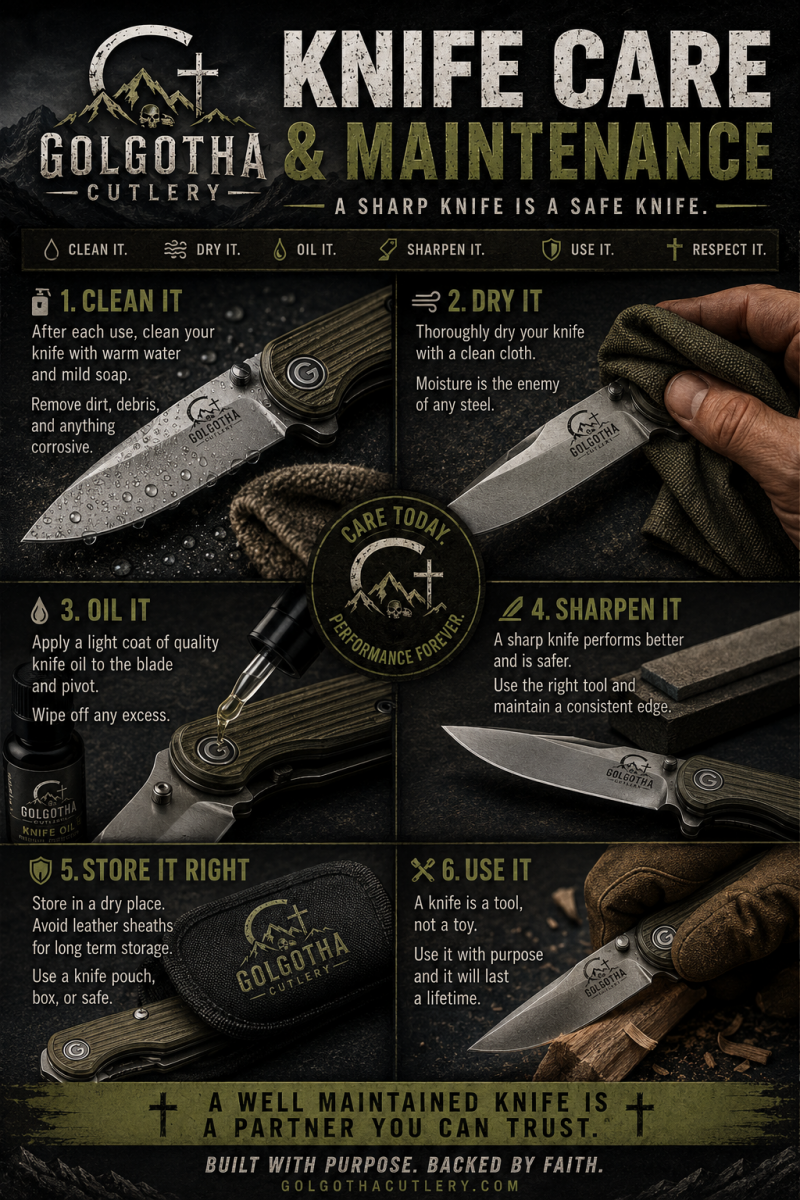
GOLGOTHA KNIFE MAINTENANCE GUIDE
Simple care. Better performance. Longer life.
A good knife doesn’t need complicated maintenance. A few basic habits will keep your knife cleaner, smoother, sharper, and ready to work when you need it.
Step 1: Wipe It Down After Use
After using your knife, wipe the blade clean with a soft cloth.
If you’ve cut food, tape, cardboard, sap, or anything that leaves residue behind, clean it sooner rather than later. Dirt and moisture left on the blade can lead to staining, corrosion, or rough operation.
For stubborn residue, use a damp cloth with a little mild dish soap, then wipe the blade clean.
Avoid soaking a folding knife in water.
Step 2: Dry It Completely
Moisture is one of the biggest enemies of knife steel.
After cleaning, dry the blade, handle, pivot area, and any exposed hardware thoroughly.
Pay extra attention if your knife has been used in rain, around sweat, near saltwater, or in humid conditions.
Never put a wet knife away for storage.
Step 3: Apply a Light Coat of Oil
A small amount of quality knife oil can help protect the blade from corrosion.
You do not need to soak it.
Place a drop or two on the blade and spread it into a very thin coating with a clean cloth.
For folding knives, occasionally place a tiny drop of lubricant near the pivot. Open and close the knife several times to distribute the oil, then wipe away the excess.
Too much oil simply attracts dirt and lint.
Step 4: Check the Pivot and Hardware
Every so often, inspect your knife.
Check the pivot screw, handle screws, pocket clip, and other hardware for anything that has worked loose.
If something is loose, gently tighten it with the correct-size tool.
Do not overtighten the pivot. A pivot that is too tight can make the knife difficult to operate.
Step 5: Keep the Edge Sharp
Don’t wait until your knife is completely dull before sharpening it.
A slightly dull knife is much easier to touch up than a severely dull one.
For beginners, a guided sharpening system, ceramic rod, or simple fixed-angle sharpener can make learning easier.
Use light pressure and work slowly. Maintaining a consistent angle is more important than sharpening aggressively.
Step 6: Remove the Sharpening Burr
As you sharpen, a very small burr can form along the edge.
Finish with lighter passes on both sides of the blade until that burr is removed.
You can then lightly strop the knife on leather if desired.
A properly finished edge should feel clean and sharp rather than rough or wire-like.
Step 7: Clean the Inside of Folding Knives
Pocket knives collect lint, dust, dirt, and debris.
Use a soft brush, cotton swab, compressed air, or wooden toothpick to gently clean around the liners, pivot, lock, and other hard-to-reach areas.
Avoid aggressively scraping internal surfaces with metal objects.
Step 8: Take Care of the Handle
Different handle materials require slightly different care.
G10, FRN, Micarta, aluminum, titanium, and most synthetic handles can usually be wiped clean with mild soap and water.
Wood and other natural materials should not be soaked. Wipe them gently and keep them reasonably dry.
Micarta may darken as it absorbs oils from your hands. That is normal.
Step 9: Store It Properly
Store your knife somewhere clean and dry.
For long-term storage, avoid leaving carbon-steel or tool-steel blades inside leather sheaths. Leather can retain moisture and contribute to corrosion.
A knife pouch, case, display box, drawer, or other dry storage location works well.
For blades that are prone to corrosion, apply a light protective coat of oil before storage.
Step 10: Inspect Your Knife Regularly
Every few weeks—or more often if you carry your knife daily—give it a quick inspection.
Look for rust, loose screws, blade play, damaged edges, cracks, unusual lock movement, or anything else that seems different.
Catching a small problem early is usually easier than repairing a neglected knife later.
A Few Things Not to Do
Don’t use your knife as a screwdriver, pry bar, chisel, hammer, or can opener unless it was specifically designed for that job. Don’t intentionally twist the blade while cutting, and don’t force a folding knife if something feels wrong.
A knife is a cutting tool. Using it like one is one of the best ways to make it last.
Golgotha Beginner Rule
Clean it. Dry it. Oil it lightly. Keep it sharp. Store it dry.
That’s really the foundation of knife maintenance.
You don’t need a workbench full of expensive equipment. Take care of your knife regularly, and it will take care of the work you bought it to do.
GOLGOTHA CUTLERY
Purpose Has An Edge.