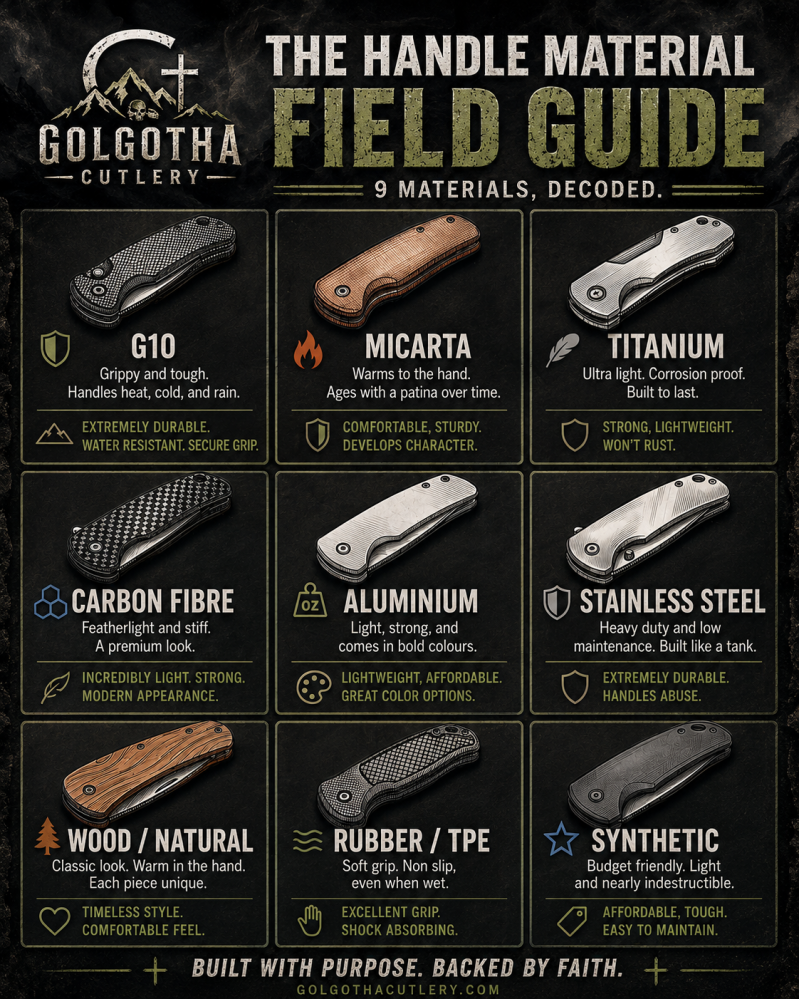
Beginner’s Guide to Knife Handle Materials
G10, Micarta, Carbon Fiber, Aluminum, Wood & More
When shopping for a knife, most people immediately look at the blade.
What steel is it? How long is the blade? What shape is it?
Those things matter—but don’t overlook the handle.
The handle is the part of the knife you actually hold, and its material can affect the knife’s grip, weight, durability, appearance, comfort, maintenance, and price.
If terms like G10, Micarta, FRN, carbon fiber, titanium, and aluminum don’t mean much to you yet, this guide will help.
You don’t need to become an expert. You just need to understand the basics.
Why Does Handle Material Matter?
Two knives with similar blades can feel completely different simply because they’re made with different handle materials.
Some materials are lightweight. Some provide excellent grip. Some are chosen for durability, while others are prized for their appearance.
Just like blade steel, there isn’t one handle material that’s best for every knife.
The right choice depends on how you plan to use and carry it.
Let’s look at some of the materials you’re most likely to encounter.
G10
G10 is one of the most common handle materials on modern EDC and working knives.
It’s made from layers of fiberglass cloth combined with resin under pressure and heat. The result is a strong, stable material that works extremely well for knife handles.
G10 can also be machined with different patterns and textures to provide additional grip.
Why Knife Makers Use G10
- Strong and durable
- Good grip
- Resistant to moisture
- Available in many colors and textures
- Relatively lightweight
- Requires very little maintenance
For an everyday working knife, G10 is an excellent all-around handle material.
That’s one reason you’ll see it used on many Golgotha knives.
Micarta
Micarta is another extremely popular material, especially among people who like a more traditional or rugged appearance.
It’s generally made by combining layers of materials such as canvas, linen, or paper with resin.
Depending on the material used and how it’s finished, Micarta can have a very distinctive texture.
One interesting characteristic is that Micarta can gradually change appearance as it absorbs oils from your hands. Many knife enthusiasts actually enjoy this because the handle develops its own character over time.
Why People Like Micarta
- Comfortable in the hand
- Rugged appearance
- Available in different textures
- Durable
- Each piece can develop its own character
- Excellent choice for both folders and fixed blades
Micarta has a warmer, more natural feel than many synthetic materials, which is part of its appeal.
Carbon Fiber
Carbon fiber is commonly associated with higher-end modern knives.
It’s made from extremely thin carbon fibers combined into a composite material. The result can be very strong while remaining extremely lightweight.
Carbon fiber also has a distinctive woven appearance that gives knives a modern, premium look.
Why People Like Carbon Fiber
- Very lightweight
- Strong
- Distinctive appearance
- Resistant to corrosion
- Gives a knife a premium feel
You’ll find several different types and patterns of carbon fiber in the knife world, so two carbon-fiber handles won’t necessarily look or feel exactly the same.
FRN
FRN stands for Fiberglass Reinforced Nylon.
It’s a lightweight synthetic material frequently used on affordable and practical EDC knives.
FRN handles can be molded with aggressive textures and patterns that provide surprisingly good grip without adding much weight.
Why Knife Makers Use FRN
- Very lightweight
- Durable
- Resistant to moisture
- Easy to texture for additional grip
- Affordable
- Available in many colors
Don’t mistake inexpensive for ineffective.
A well-designed FRN handle can make an excellent everyday working knife.
Aluminum
Aluminum is another popular choice for modern folding knives.
It provides the solid feel of a metal handle without adding the amount of weight you’d expect from heavier metals.
Aluminum knife handles are often anodized, which can add color and help protect the surface.
Why People Like Aluminum
- Lightweight for a metal handle
- Strong
- Clean, modern appearance
- Available in many finishes and colors
- Solid feel in the hand
Aluminum works especially well when you want a knife to feel substantial without becoming excessively heavy.
Titanium
Titanium is commonly found on premium folding knives.
It’s valued because it provides an impressive combination of strength, relatively low weight, and excellent corrosion resistance.
Titanium is also frequently used on frame-lock knives, where part of the handle itself becomes part of the locking mechanism.
Why People Like Titanium
- Strong
- Excellent corrosion resistance
- Relatively lightweight
- Premium appearance and feel
- Works especially well with frame-lock designs
Titanium generally costs more than materials such as G10 or FRN, which is one reason it’s more common on higher-priced knives.
Stainless Steel
Some folding knives use stainless steel handles.
Steel provides a very solid feel and can be extremely durable. It can also be finished in many different ways, including satin, stonewashed, polished, coated, or engraved surfaces.
Why Knife Makers Use Stainless Steel Handles
- Strong
- Durable
- Corrosion resistant
- Solid feel
- Classic or modern appearance depending on the design
Steel handles generally add more weight than aluminum, titanium, or synthetic materials, but some users actually prefer that substantial feeling.
Wood
Wood has been used for knife handles for generations, and it’s still popular today.
Different woods can produce dramatically different colors, grain patterns, and appearances.
You’ll find wood handles on everything from traditional pocket knives to hunting knives, fixed blades, and modern folders.
Why People Love Wood
- Natural appearance
- Warm feel in the hand
- Each piece can be visually unique
- Works beautifully on traditional and modern designs
- Available in many species and colors
Wood generally requires a little more care than synthetic materials. It shouldn’t be unnecessarily soaked in water, and extreme changes in moisture and temperature can affect some natural materials.
With reasonable care, however, a quality wood handle can last for many years.
Bone
Bone is especially common on traditional pocket knives.
It can be left smooth or given patterns such as jigging, then dyed in a huge variety of colors.
Because bone is a natural material, slight variations are normal—and that’s part of what makes traditional knives interesting.
Why People Like Bone Handles
- Classic appearance
- Traditional knife heritage
- Wide variety of colors
- Can be smooth or jigged
- Natural variation makes individual knives unique
As Golgotha expands into traditional pocket knives, this is a handle material you’re likely to see more often.
Other Natural Materials
The knife world doesn’t stop with wood and bone.
Depending on the manufacturer and knife, you may also encounter materials such as stag, horn, mother-of-pearl, shell, and other natural materials.
These are often chosen as much for their appearance and character as their practical performance.
They’re especially popular on traditional, collectible, and presentation knives.
What Are Liners?
Sometimes what you see on the outside of a knife isn’t the entire handle structure.
Many folding knives use metal liners underneath the handle scales.
For example, a knife might have G10 scales attached to stainless-steel liners.
The G10 provides the exterior surface you hold, while the liners can add structural support and may also form part of the knife’s locking mechanism.
That’s why you’ll sometimes see specifications listing both a handle material and a liner material.
What Are Handle Scales?
You’ll also hear knife enthusiasts talk about scales.
The scales are simply the pieces of material attached to the sides of the knife’s handle.
If someone says:
“This knife has G10 scales,”
they’re talking about the exterior G10 pieces that form the gripping surfaces of the handle.
On some knives, those scales can even be removed and replaced, allowing owners to customize their knife.
Texture Matters Too
The material itself is only part of the story.
How the handle is shaped and textured can be just as important.
Smooth G10 and heavily textured G10 can feel completely different.
The same is true for Micarta, carbon fiber, aluminum, and other materials.
Manufacturers can machine grooves, patterns, contours, and other features into handles to improve grip or simply change the appearance.
A good knife handle isn’t just about what it’s made from.
It’s about how the entire handle is designed.
Which Handle Material Is Best?
Just like blade steel, there’s no single correct answer.
If you want a rugged everyday working knife, G10 or Micarta can be excellent choices.
If keeping weight down is important, FRN or carbon fiber may appeal to you.
If you prefer metal construction, aluminum or titanium may be more your style.
If you appreciate traditional knives and natural materials, wood or bone might be exactly what you’re looking for.
The best handle material is the one that gives you the combination of comfort, grip, durability, weight, appearance, and price that works for you.
Don’t Choose a Knife by One Specification
It’s easy to get caught up in specifications.
Premium blade steel doesn’t automatically make a great knife, and neither does an expensive handle material.
A good knife brings everything together:
Blade steel. Heat treatment. Blade geometry. Locking system. Handle material. Ergonomics. Fit and finish.
Most importantly, it should work for the person carrying it.
Understanding handle materials simply gives you one more tool for making a better decision when choosing your next knife.
You don’t need the most expensive material.
You need the right knife for the job.
Golgotha — Purpose Has An Edge.