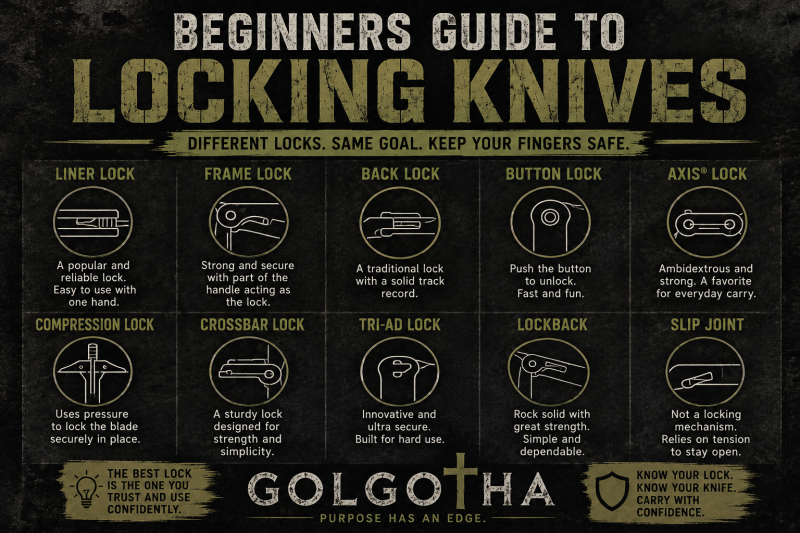
Beginner’s Guide to Knife Locks
Liner Locks, Button Locks, Frame Locks, Crossbar Locks & More
You’ve found a knife you like. The blade steel sounds good. The handle feels great.
Then you read the specifications:
Lock Type: Button Lock.
Or maybe it says liner lock, frame lock, crossbar lock, back lock—or something else entirely.
And you’re thinking:
Okay…what does that mean?
You’re in the right place.
Knife locking systems can sound complicated when you’re first getting into knives, but the basic idea is pretty simple. This guide will introduce you to some of the most common systems you’ll encounter and explain how they work.
Why Do Folding Knives Have Locks?
A folding knife has one obvious challenge that a fixed blade doesn’t:
The blade folds.
When you’re using a folding knife, you generally don’t want the blade unexpectedly closing toward your fingers.
A locking mechanism is designed to hold the blade in the open position until you intentionally release the lock.
Different manufacturers have developed many ways of accomplishing this, but they all serve essentially the same purpose:
Keeping the blade securely open during normal use.
It’s important to remember that no locking system makes a folding knife indestructible. A folding knife should still be used as a cutting tool rather than a pry bar, screwdriver, or chisel.
Now let’s look at some common lock types.
Liner Lock
The liner lock is one of the most common locking mechanisms you’ll encounter on modern folding knives.
Inside the handle is a metal liner. When the blade opens, part of that liner moves inward behind the blade’s tang, preventing the blade from rotating closed.
To close the knife, you move the liner away from the blade and carefully fold the blade back into the handle.
Why Liner Locks Are Popular
- Simple design
- Easy to manufacture
- Reliable when properly designed
- Allows relatively slim knife designs
- Extremely common on affordable and premium knives
If you collect modern EDC knives, you’ll almost certainly own a liner lock eventually.
Probably several.
Okay…probably more than several.
Frame Lock
A frame lock works on a similar principle to a liner lock.
The major difference is that instead of an internal liner moving behind the blade, part of the knife’s handle frame itself acts as the locking bar.
When the blade opens, that section of the frame moves inward and engages the blade tang.
Frame locks are commonly associated with metal handles, particularly titanium and stainless steel.
Why People Like Frame Locks
- Simple construction
- Solid engagement
- Fewer separate internal components
- Common on premium EDC knives
- The handle itself becomes part of the locking system
If you’ve seen a titanium folding knife with one side of the handle moving inward behind the blade, you’ve probably seen a frame lock.
Button Lock
Button locks have become extremely popular on modern EDC knives.
As the name suggests, there’s a button on the handle that controls the locking mechanism.
When the blade is open, the internal mechanism prevents it from closing. Pressing the button disengages the lock and allows the blade to move.
One reason people enjoy button locks is that your fingers generally don’t need to move directly into the blade’s closing path to disengage the lock.
There’s another reason they’re popular:
They’re fun.
If you’ve ever sat on the couch opening and closing a button-lock knife far more times than necessary…
Don’t worry.
You’re among friends.
Why People Like Button Locks
- Easy to operate
- Convenient for everyday carry
- Keeps fingers away from the blade’s closing path during lock release
- Works well for right- or left-handed operation on many designs
- Let’s be honest—they’re satisfying to use
You’ll find button locks on several modern Golgotha designs.
Crossbar Lock
A crossbar lock uses a bar that moves across the handle and engages the blade tang when the knife is open.
You’ll usually see controls on both sides of the handle that allow the user to pull the bar backward and disengage the lock.
Different manufacturers use different names and variations of this general design.
Why People Like Crossbar Locks
- Ambidextrous operation
- Fingers can remain away from the blade’s closing path
- Smooth operation
- Popular for everyday carry
- Easy to operate with either hand
Crossbar-style locks have become extremely common in modern folding knives.
Back Lock / Lockback
The back lock, often called a lockback, is one of the classic folding-knife locking systems.
A locking bar runs along the spine of the handle and engages the blade when it’s opened.
To close the knife, you press the exposed portion of the locking bar, which disengages it from the blade.
You’ll find variations of this design on everything from traditional pocket knives to modern tactical and outdoor folders.
Why Back Locks Have Stuck Around
- Proven design
- Simple operation
- Strong lockup when properly designed
- Long history in folding knives
- Works well on traditional and modern designs
It’s an old-school design that still works extremely well.
Compression Lock
A compression lock uses a locking tab that engages between the blade tang and a stop pin.
You’ll generally operate the lock from the spine side of the handle rather than reaching across the blade’s closing path.
This system is strongly associated with certain modern folding-knife designs and has earned a loyal following.
Why People Like Compression Locks
- Convenient operation
- Fingers remain away from the closing blade
- Strong locking design
- Smooth operation
It may look unusual the first time you encounter one, but the basic purpose is still the same: securely holding the blade open until you’re ready to close it.
Other Locking Systems
These aren’t the only locks you’ll encounter.
The knife industry loves designing new mechanisms.
You’ll find shark-style locks, bolster locks, plunge locks, button-operated liner locks, proprietary crossbar systems, Tri-Ad-style mechanisms, and many other variations.
Some are completely different designs, while others are modified versions of familiar locking systems.
That’s part of what makes modern folding knives interesting.
You don’t need to memorize all of them.
Once you understand the basic principles behind the major lock types, figuring out a new one becomes much easier.
Wait…What About Slip Joints?
Here’s where things get interesting.
Traditional pocket knives frequently use a slip joint.
Despite sometimes being discussed alongside knife locks, a slip joint does not actually lock the blade open.
Instead, spring tension helps hold the blade in its open and closed positions.
Think of traditional knives like stockmans, trappers, Barlows, canoes, and similar patterns.
Many use slip-joint construction.
Why Are Slip Joints Still Popular?
- Simple construction
- Long history
- Excellent for traditional pocket knives
- Usually slim and comfortable to carry
- No separate lock release is necessary
Because the blade doesn’t lock, you should be particularly conscious of how you’re applying pressure while using a slip-joint knife.
Is One Knife Lock Better Than All the Others?
Not really.
Sound familiar?
It’s the same lesson you’ll hear when discussing blade steel and handle materials.
There usually isn’t one universally “best” choice.
A good liner lock can be excellent.
A good button lock can be excellent.
A good frame lock can be excellent.
The quality of the knife’s design, manufacturing, materials, tolerances, and execution matters just as much as the name of the locking system.
What Should Beginners Choose?
For your first modern folding knife, don’t overthink it.
Liner locks, button locks, frame locks, back locks, and crossbar-style locks can all be good choices when they’re properly designed and manufactured.
Instead, consider how the knife feels to you.
Can you comfortably disengage the lock?
Does the mechanism make sense?
Can you operate it confidently?
Does the blade lock open securely?
Those questions matter more than buying whatever lock happens to be popular this month.
Learn Your Knife Before You Carry It
Whenever you get a new folding knife, spend a few minutes learning how its mechanism works.
Open it slowly.
See where the lock engages.
Learn where your fingers should be when closing it.
Become comfortable with the mechanism before trying to operate it quickly.
And remember:
Your knife’s lock is a safety mechanism—not an excuse to misuse the knife.
No matter how strong the locking system may be, folding knives are primarily designed for cutting.
The Bottom Line
Knife locks seem complicated until you’ve handled a few of them.
Before long, you’ll look at a knife and immediately recognize:
That’s a liner lock.
That’s a button lock.
That’s a frame lock.
And eventually you’ll find the ones you personally prefer.
That’s part of the fun of getting into knives.
You don’t have to know everything on day one.
Learn what you’re carrying. Understand how it works. Use it responsibly. And enjoy the knife.
Golgotha — Purpose Has An Edge.